
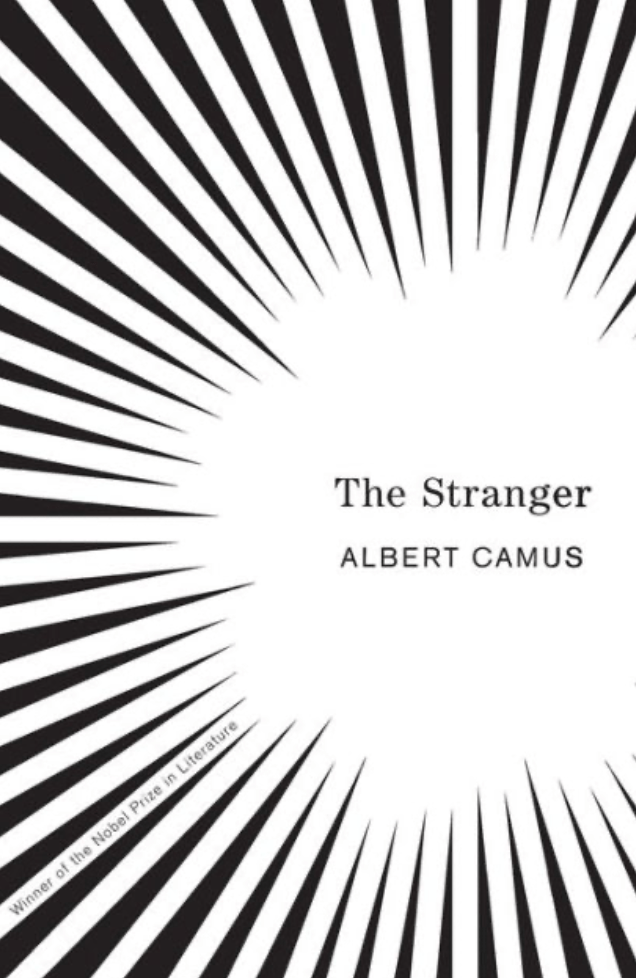
I haven’t read much Camus, but I picked up The Stranger to give a more productive critique of a friend’s upcoming novel. She is a big Camus fan, so I decided to give it a whirl. Reading this and Slaughterhouse Five on the same day was NOT good for my mental health, but it made me think, and I suppose that was the point of this entire exercise.
So many essays have been written on this book by more intelligent and accomplished scholars than I. At this point, nothing I could say could add anything of value to that conversation. So instead, I am simply going to write down my thoughts, both those on the book and those inspired by it.
The Stranger is about a man named Meursault who commits a series of “moral” infractions. He does not cry at his mother’s funeral, he does not believe in God, and he kills a man on a beach. Meursault does not subscribe to the idea that there is any inherent meaning in the universe, instead focusing on each moment as it comes. He is confused as to why many around him force meanings and intentions onto his actions. In the end, he is sentenced to death for his crimes.
The Stranger is the sort of book that takes a couple of hours to read and a couple of months to unpack. I do not identify as an “over-thinker,” though I have often been labeled as such. I think the appropriate amount to navigate my own life, and I have stopped taking feedback on the matter, therapists be damned.
I have never been a fan of “morality,” not because I do not believe in right and wrong, but because I do not think there is any simple rulebook we can all follow that does not inevitably become a tool to oppress some Other. I do not affiliate myself with any organized religion, and I do not believe in God.
But still, I want to be a “good” person. I do not strive to be kind because I want to go to heaven. I do so because pain is real, and so is joy, and those things matter whether or not anyone is keeping score. I have no patience for people who use the universe’s lack of inherent meaning to justify their own lack of empathy.
Blame and revenge have always seemed like tantalizing things to get hung up on, but at the end of the day are irrelevant. I suppose I’m a bit of a utilitarian. Our primary objective should be to minimize harm. In the United States, we are so easily distracted by the idea of punishment that we have forgotten about justice. We want so badly to make ourselves feel better about how shitty the world is by pretending that someone deserves it like there is any action or inadequacy that justifies cruelty. I don’t think there is. I believe that cruelty is a weakness, no matter the victim. However, I understand that this is not a universal opinion.
I’ve been sitting with this book for a couple of weeks. While it has not changed any of my long-held opinions, I enjoyed being given a reason to articulate them. I have made no real attempt to justify my views. This is not that kind of essay. I recommend this book to anyone who is looking for a philosophical jumping-off point.
 Tillie's Void
One thought on “Thoughts on The Stranger (Camus)”