
I have often wondered what it would be like never to die. I wouldn’t have to worry about illness, aging, or the slow but inevitable cognitive decline that leads one with varying degrees of dignity into the grave. There would be no sense of personal urgency, but I would live in fear of losing people. I would have to maximize my time with the people I loved, preparing for the day they wouldn’t be there. Maybe I should be doing that anyway.
I imagine that I would care more about the future. Current events would feel more urgent because I would live to feel their consequences. I would become progressively angrier with the incredible shortsightedness of humanity. I would double down on fighting global warming. I would fight tooth and claw for a better world. Again, maybe I should be doing that anyway.
If I were to live forever, I would be afraid of attachments. Once my family and friends had passed, I would be reluctant to open myself up again to that pain. I know this because I have already lost people, and the anxiety of it happening again perpetually infects my remaining relationships. Maybe time would heal all wounds, or maybe not. My life hasn’t been long enough for me to know yet.
I don’t know if I would remember my whole impossibly long life. I’m in my mid-twenties, and there are more holes in my memory than Swiss cheese. I ran into someone I went to high school with recently, and she kept going on about things I was supposed to know while I was fishing for her name. Maybe as time faded the memories of my many lives I would become someone new. If you take one brain and fill it with memories, but it only has a certain fixed carrying capacity, would the older ones be displaced as the years went on? At what point would I stop being me? Would I really never die, or would I be limited forever by the wiring of a brain that’s only built to last a hundred or so years? The mind of Theseus.
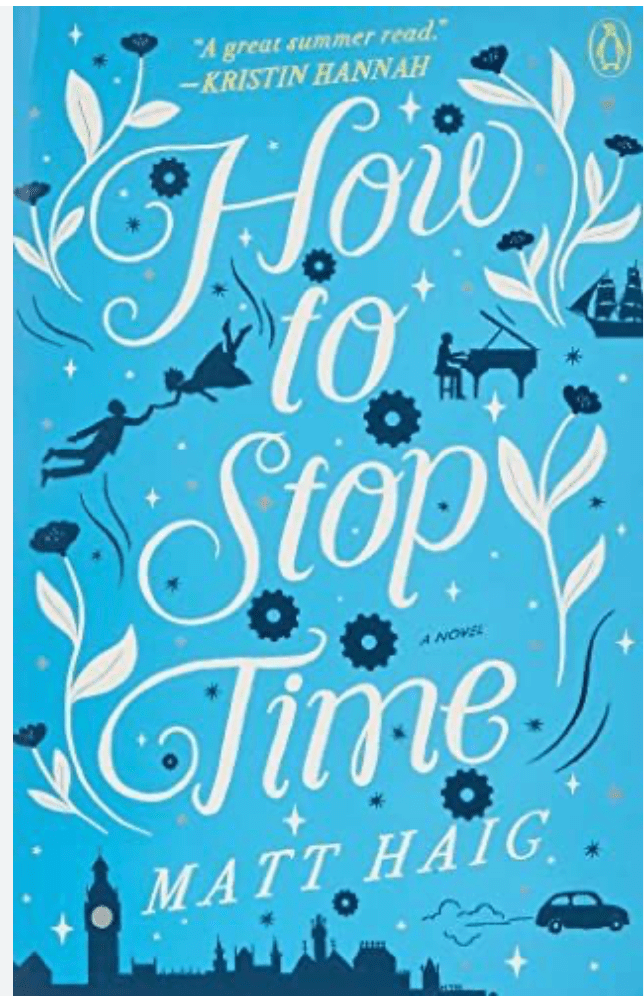
I’ve been thinking about these things since reading How to Stop Time. In Matt Haig’s novel, Tom Hazard moved back to London to be a high school history teacher. He looks like he’s in his 40s, but in reality, he is much, much older, having lived hundreds of lives all over the world. Tom has a rare condition that causes him to age incredibly slowly. He is a member of the Albatros Society, an organization of impossibly long-loved individuals dedicated to finding others like them and remaining undetected by the rest of the world. The only rule is that they aren’t allowed to fall in love.
In his lifelong search for his lost daughter, Tom has lived an isolated life, not connecting to anyone or anything. As the story begins, he has grown tired of his life in the society and wants something different, something ordinary and small and safe. Eventually, he learns to see his life in a new way, forges real connections, and manages to fall in love for the first time in hundreds of years. The book’s highlights (in my opinion) are the flashbacks to important moments in his personal history, painting a picture of a life only partly lived despite its longevity.
I liked this book. After reading The Midnight Library, I looked forward to reading more of Haig’s work. I blew through How to Stop Time in about a day and highly recommend Haig’s work to anyone who enjoys simple yet well-developed thought experiments and beautiful language. I like the way he weaves in thoughts on life and mental health without becoming too preachy, making it evident that these are struggles he intimately understands.
Overall, this was a good book, but acknowledging its weaknesses is essential for me to grow as a writer myself. I need to identify not only what I hope to emulate but also things that I want to avoid in my work.
The flashbacks peppered throughout the narrative reveal that Tom has lived an amazing life. He performs with William Shakespeare, sails with Captain Cook, and runs into Fitzgerald in a bar. But because the flashbacks were so focused on name-dropping historical figures, they missed out on an opportunity to flesh out Tom’s character. He becomes a man defined by the things he has seen, not the person he is.
How to Stop Time is fundamentally a love story, but surprisingly little of the book focuses on either of Tom’s loves. Even his daughter, whose existence is Tom’s primary motivation throughout the book, is given a clear aesthetic but not a personality. Tom’s ability to let love into his life is a purely personal development with little or nothing to do with the people around him. While this may be reasonable given Albatros society’s condescending opinion of outsiders, it limits Tom’s personal growth. It also makes the world feel flat, like we, the reader, are stuck in Tom’s head as much as he is.
Tom’s relationship with Camille is notably lacking. She is French, has lost someone in the past, and is remarkably accepting of the implausible. That’s all I know about her. Don’t get me wrong, she isn’t a bad character or person. I liked her, but I didn’t know her. In my opinion, neither Tom nor the reader knows her well enough to explain why she is the first woman in centuries for him to have real feelings for. She is viewed through old Facebook posts, glances in the park, and brief exchanges, but she never solidified into a person for me. She was always more of an idea, a hypothetical, an alternative to the life he didn’t want anymore.
I prefer books with a fuller array of characters, all of which feel real, and this book doesn’t have that. Does not make it a bad book? No. Tom’s character development isn’t about finding someone worth breaking the rules for. It’s about him being ready to finally experience the world in a new and forbidden way. That’s fine. It just wasn’t what I wanted it to be.
 Tillie's Void
2 thoughts on “Thoughts on How to Stop Time (Matt Haig)”